


Blog Tour: THE YEAR OF SHADOWS by Claire Legrand (Guest Post & Giveaway)

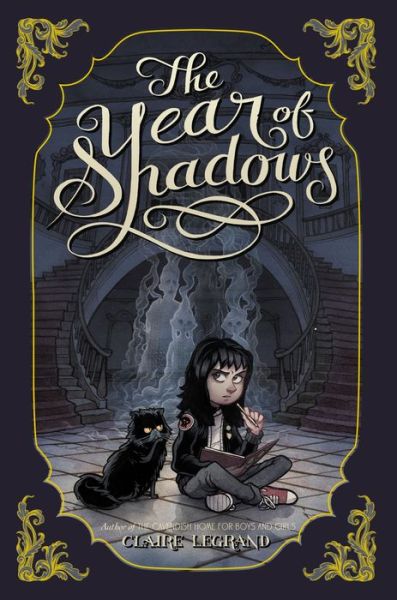
Title: THE YEAR OF SHADOWS
Author: Claire Legrand
Publisher: Simon & Schuster Books for Young Readers
Release Date: August 27, 2013
Number of Pages: 416
Source of Book: ARC from publisher
Olivia Stellatella is having a rough year.
Her mother left, her neglectful father — the maestro of a failing orchestra — has moved her and her grandmother into his dark, broken-down concert hall to save money, and her only friend is Igor, an ornery stray cat.
Just when she thinks life couldn’t get any weirder, she meets four ghosts who haunt the hall. They need Olivia’s help — if the hall is torn down, they’ll be stuck as ghosts forever, never able to move on.
Olivia has to do the impossible for her shadowy new friends: Save the concert hall. But helping the dead has powerful consequences for the living . . . and soon it’s not just the concert hall that needs saving.
 Claire Legrand used to be a musician until she realized she couldn’t stop thinking about the stories in her head. Now a writer, Ms. Legrand can often be found typing with purpose at her keyboard, losing herself in the stacks at her local library, or embarking upon spontaneous adventures to lands unknown. Her first novel is THE CAVENDISH HOME FOR BOYS AND GIRLS, a New York Public Library Best Book for Children in 2012. Her second novel, THE YEAR OF SHADOWS, releases August 27, 2013, with her third novel, WINTERSPELL, to follow in fall 2014. She is one of the four authors behind THE CABINET OF CURIOSITIES, an anthology of dark middle grade fiction due out in July 2014 from Greenwillow Books/HarperCollins. Claire lives in New Jersey with a dragon and two cats. Visit her at claire-legrand.com and at enterthecabinet.com.

excited to be here at Heise Reads & Recommends for day 14 (yowza!) of The Year of Shadows blog tour!
I’ll be giving you a sneak peek into the revision process for The Year of Shadows—and I’ll admit, I’m
a little nervous! Although revising is a normal, necessary part of the writing
process (and my favorite part of the
process, in fact), I’m always irrationally frustrated that I can’t just, you
know, write the book the way it needs to be written the first time around. Admitting that I’m unable to do that, and
sharing what I’ve put my book through to make it shine, wounds my pride.
pride is silly; no one can write a good book without also putting that book
through revisions—and maybe even rewrites! So, with that in mind, let’s take a
look at how The Year of Shadows evolved
from wee baby manuscript to shiny final book.
inimitable editor, Zareen Jaffery, and I have worked together on three books
now, and the revision process for each started the same way: Zareen sent me a
thorough, thoughtful editorial letter. Each letter began with her overall
thoughts about the book in question, and then continued with sub-sections of
comments focused on major characters, world building elements, and themes.
asks a lot of questions in her editorial letters, which I love. Instead of
telling me, “This needs to be this way instead of that way” or “Do this here
instead of that,” she asks me questions that prompt me to think more critically
about what I’ve written. With The Year of
Shadows, our main focuses during revisions were 1) world building (the hows
and whys of the ghosts and their anchors), 2) pacing (there’s a lot going on in
this book!), and 3) Olivia herself. Olivia is a complex heroine, and it was
important to me that readers fully understood the motivations behind her anger,
bitterness, and loneliness.
the most important relationships in the book is between Olivia and her father,
the Maestro. The nuances of this complicated relationship took a while for me
to get just right. In that first editorial letter, Zareen asked some great
questions about their relationship:
Olivia’s eyes. But, just
of him softens, I’d like to introduce a more complicated reasoning
where he is verbally abusive
understand why the Maestro is so mean to Olivia. Neglectful I can justify. But
to lash out at her and accuse her of wanting him to be ruined? That seems so
unnecessary. Why does he do this?
up excellent points here. I could have easily made the Maestro a
one-dimensional villain, and in fact, he was much less complex and sympathetic
in this early draft. But the world isn’t black and white, as much as angry
Olivia might at first see it that way, and the Maestro is no exception. By doing
just as Zareen suggested—softening some of the passages where he is more
temperamental, and giving the reader (and Olivia) more of an insight into why he acts the way he does—I was able
to create a much more well-rounded character in the Maestro.
excerpt from the first draft of the manuscript. Olivia snuck into her father’s
room during a concert, searching for a ghost’s anchor. When the Maestro finds
her there, he gets angry:
Maestro whispered. His eyes were wild, but I wasn’t afraid. I could think only
about those unopened letters, one after another after another.
bedroom, just as dirty as it had been before. “And what a cleaning job. Perhaps
you will tell me the truth now?”
Walter to ruin me!”
Olivia.”
from my cheek. “I didn’t know Mr. Rue’s first name, so sue me!”
secrets,” he said, pointing a shaking finger at me. “Secrets to share with him,
to speed up the process. You want me to fail just as he does, don’t you? You
would love to see this Hall crumble to dust, see me turn to dust!”
wild. I had never seen the Maestro this angry, all crazy-eyed and deathly
quiet.
crazy,” I said, backing away. “Just look at you. No wonder Mom left.”
unstable the Maestro seems? How his words and attitude border on violent?
Olivia even seems afraid of him. He calls her an “awful child”! It’s all a bit
cartoonish and over-the-top. Compare that with the same passage from the final
book:
was in his full-blown post-concert state—skin flushed and sweating, hair wild,
the permanent bags under his eyes even darker than normal. People didn’t like
to mess with the Maestro after concerts, especially not these days. But I could
think only about those unopened letters, one after another after another.
bedroom. “And what a cleaning job. Perhaps you will tell me the truth now?”
without their permission, Olivia.” The Maestro wiped his face with a stained
handerchief. “I give you your privacy. You should give me mine.”
you.” The sight of him repulsed me. He was too sweaty and too skinny and too
tired. “No wonder she left.”
is more subtle in the final version of the scene. We see signs of the Maestro’s
exhaustion—the bags under his eyes, the stained handkerchief. We even see that
Olivia knows how tired she is—and maybe, underneath her anger, feels sorry for
him. Instead of raging at Olivia, the Maestro calmly admonishes her for going
through his belongings. This allows both Olivia—and the reader—to feel more
sympathy for him. We see a man overwhelmed by terrible circumstances, rather
than a man bordering on abusive—but we still understand Olivia’s anger toward
him.
another great point made by Zareen in her editorial letter:
mother… except for the little detail that Cara left her, which Olivia seems to
blame solely on her father. Why doesn’t Olivia blame her mother more?
read this, I felt, I confess, a bit flabbergasted. Of course Olivia would blame
her mother! Why didn’t I think about this before? (This is a common refrain
during the revisions process, by the way, and why editors are so invaluable. By
asking all the right questions, they help you discover nuances of the story
that you missed the first time around, and help clarify sentiments you thought you had expressed clearly but ended
up getting lost on the page.) I realized that Olivia should want her mother
back, yes, and miss her, and most of her anger should be focused at the parent
who is actually present, the parent easy to blame—the Maestro—but she should
also be angry at her mother, and then feel guilty for that anger. Because of
this great question from Zareen, I was able to tease out a whole new level of
emotion from Olivia, and add another layer of emotional conflict to the story.
that Zareen didn’t say, “Olivia should blame her mother more.” She asked, “Why
doesn’t Olivia blame her mother more?” Good editors don’t direct; they guide,
nudge, inspire. If I had a solid reason for Olivia not blaming her mother, I
could have explained it to Zareen, and she would have accepted that. But even
in that case, her question would have made me re-examine my thought process.
entire passages didn’t make it into the book, passages that were fun for me to
write but derailed the story’s focus. In an early draft of the book, I added a
Greek chorus of three elderly men who liked to sit on the bench outside Emerson
Hall. Olivia talked to them occasionally, and they offered advice or just
uttered entertaining non-sequiturs. But their addition slowed the overall
pacing, so I ended up deleting them entirely. For fun, here is their first
appearance from an early draft:
up against the wall of the Hall. It was green and its paint was peeling, and
there were these three guys that sat there most mornings, watching the traffic
and reading the paper. One was Hat Guy (he wore a hat). One was Cigar Guy (he
liked cigars). The third was Cool Guy (he wore sunglasses, even if it was
raining).
and they never asked me mine. It was this unspoken thing of ours. Used to, they
called me Music Girl. You know, being the daughter of an orchestra conductor
and all.
months ago, they started calling me Shadow Girl. I wore black a lot now. My
hair was long and black, too, and shiny, and I wore it down most of the time. I
liked to hide behind it and pretend I wasn’t even there.
Guy said.
his paper. Cool Guy chewed his gum.
wrong.”
on back inside.”
hiding my face., I didn’t want the Bench Guys to see me cry.
proceedings. I transferred any useful exposition from their deleted scenes into
scenes that already existed, thereby streamlining the story’s pacing. I am,
however, still quite fond of Bench Guys. Maybe they need their own story
someday! And that’s something important to remember about revisions: Sometimes
the nature of the book requires you to delete favorite passages, characters,
even entire storylines! This can be painful. But just because this material
doesn’t fit into this book doesn’t mean
you can’t re-work it for use in another book.
letter into the manuscript, I send the updated version to Zareen. Sometimes we
talk over the phone about the changes I’ve made before she reads the newest
draft. Zareen then begins line edits, leaving comments throughout the
manuscript. Sometimes she will also send another, much more brief editorial
letter addressing any remaining, overarching issues, but the bulk of edits this
time around are on the micro level rather than the macro level.
repetition, to world building clarification and consistency, to making sure
there’s enough Igor. (Igor is Olivia’s cat, and he seems to be a huge fan
favorite.) Zareen also, blessedly, includes a lot of positive comments in her
line edits: “I love this!” or “Such a great moment!” or “AWESOME visual.”
Revisions can be both exhilarating and excruciating. Those tiny, happy comments
are welcome boosts to my morale!
right now he’s touching her cheek. Rephrase? (Ah! Such a tiny but important inconsistency. Good catch, Zareen!)
traumatic! Would they so easily agree? (No,
they wouldn’t agree so easily! Hence why, in the final book, Olivia and Henry
are much more reluctant to help the rest of the ghosts, and end up having to
find help because they simply can’t handle the stress.)
growing? (Yes! In the final book, I
emphasize everyone’s excitement about the growing audience, and even brought
the press into the mix.)
comfort her? (Answer: ALWAYS MORE
IGOR.)
revision process for The Year of Shadows!
Revisions can be tough—but they can also be the most rewarding part of bringing
a book to life. I know they are for me! As they say, revisions are where the
real writing begins, when you take the huge hunk of marble that is drafting and
start chipping away at it to turn it into something truly beautiful. (For a
more humorous take on the editorial process, check out this post on
my blog, illustrated by yours truly.)
chance to win a beautiful hardcover copy of The
Year of Shadows! And you can check out the other blog tour stops here for
multiple chances to win!
PURCHASE LINKS:
amazon | barnes & noble | the book depository | indiebound | books-a-million | itunes

I think that if I were a writer revisions would be the hardest because I have heard of writers having to cut out thousands or even TENS of thousands, words and that would kill me to do that.
Ooo… can I say I just don't have the discipline to be a writer? The times I've tried, my brain tries to the the drafting and revising all at once, and I give up in frustration.
I'm not a writer but revising would be the hardest for me. I would constantly keep re-writing everything lol
I love the revision process. Seeing the story go from "eh- it tells a story and it sorta makes sense" to wow! this book is so much better than I thought! is always a good experience, even if it's painful. I love editors!!
I've never actually gotten past the drafting stage when writing a book, but whenever I have to revise something for like, school or something I just HATE it so I think they're both equally hard, but for different reasons, if that makes sense.
I would think that getting everything out in a manner that pleased me would be the hardest part. It was always the hardest for me in school. Revising was always much easier, because I was just polishing rather than creating from scratch.
Hmm, I think I enjoy drafting more, but I get more satisfaction from revision. This was a really interesting post! Thanks for the backstage look at your revision process 🙂
I think drafting would be harder because it is, to my estimation, harder to create than to manipulate.
Revising!! Because there are all these different components which you have to look at critically and make sure they all work together perfectly:)
Thank you! LOVE this post:) Thank you for sharing Claire! 🙂
Revising would be much harder. You are having to second guess your instincts.